The First Years of Fdrs Administration Were Focused on Creating Jobs and Getting the Moving Again
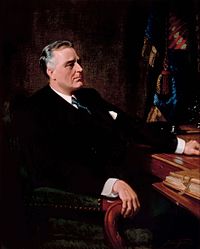
As president from 1933 to 1945, Roosevelt was the target of sharp criticism from both left and right.
Before, during and later his presidential terms and continuing today, there has been much criticism of Franklin D. Roosevelt (1882–1945). Critics have questioned not just his policies and positions, merely also charged him with centralizing power in his own hands by decision-making both the government and the Democratic Political party. Many denounced his breaking of a long-continuing tradition past running for a 3rd term in 1940.[1]
Past the middle of his 2nd term, much criticism of Roosevelt centered on fears that he was heading toward a dictatorship by attempting to seize control of the Supreme Court in the courtroom-packing incident of 1937, attempting to eliminate dissent inside the Democratic Party in the Southward during the 1938 mid-term elections and by breaking the tradition established past George Washington of not seeking a tertiary term when he again ran for re-ballot in 1940. As two historians explicate: "In 1940, with the two-term issue as a weapon, anti-New Dealers [...] argued that the time had come to disarm the 'dictator' and to dismantle the machinery".[two]
Long afterwards Roosevelt's death, new lines of assail opened to criticize his policies regarding helping the Jews of Europe,[3] incarcerating Japanese Americans on the West Declension in concentration camps,[4] and opposing anti-lynching legislation.[5]
Rejection by allies [edit]
Numerous allies and appointees turned confronting Roosevelt,[ why? ] such equally Vice President John Nance Garner, Brain truster Raymond Moley, Postmaster General James A. Farley[half dozen] and Ambassador Joseph Kennedy.[7] Outside the administration prominent supporters who turned against Roosevelt included journalists Walter Lippmann[viii] and Frank Kent.[9] Newspaper publisher William Randolph Hearst was a major Roosevelt supporter in 1932, but turned his nationwide media chain against Roosevelt starting in 1934. Historian Charles A. Beard had supported Roosevelt in 1932, simply he became the leader of isolationist intellectuals who opposed his strange policy after 1937.[10] Roosevelt in the 1920s had been closely associated with Al Smith, the governor of New York. Roosevelt defeated Smith for the 1932 nomination and Smith became the leader of the Liberty League of prominent businessmen opposing the New Bargain.[11] Subsequently Pearl Harbor, Roosevelt rejected the possibility of major war jobs for any of these men except Lewis Douglas[12] and Dean Acheson.[13] Some appointees privately turned against the New Deal, simply they kept tranquility and stayed in the jobs, such as ambassador Claude Bowers.[14]
Criticism of the New Deal and of revenue enhancement policy [edit]
Roosevelt was criticized for his economic policies, especially the shift in tone from individualism to collectivism with the dramatic expansion of the welfare state and regulation of the economy. Those criticisms connected decades afterward his decease. 1 gene in the revisiting of these issues in later decades was the ballot of Ronald Reagan in 1980.[15] When in 1981 Reagan was quoted in The New York Times saying that fascism was admired past many New Dealers, he came under heavy criticism, for Reagan had greatly admired Roosevelt and was a leading New Dealer in Hollywood.[xvi] Ane of the most outspoken critics of the New Deal in the 1930s was the correct-wing activist Elizabeth Dilling.[17] [eighteen]
Today, Roosevelt is criticized past conservatives and libertarians for his extensive economic interventionism. These critics often accuse his policies of prolonging what they believe would otherwise have been a much shorter recession. Their argument is that government planning of the economic system was both unnecessary and counterproductive and that laissez-faire policies would have ended the suffering much sooner. Professor Thomas DiLorenzo, an adherent of the Austrian School of economics, says Roosevelt did not "become the states out of the Depression" or "relieve commercialism from itself" as generations of Americans have been taught.[19]
More than recently, libertarian historian Jim Powell stated in his 2003 book FDR'southward Folly that the median joblessness rate throughout the New Deal was 17.2 pct and never went below xiv percent. Even so, Powell does non count regime workers on the Works Progress Assistants (WPA) as employed, even though they worked at full-time paid jobs. Powell states the Depression was worsened and prolonged "by doubling taxes, making it more expensive for employers to hire people, making it harder for entrepreneurs to raise upper-case letter, demonizing employers, destroying food... breaking upwardly the strongest banks, forcing up the cost of living, channeling welfare away from the poorest people and enacting labor laws that hit poor African Americans especially difficult".[xx] Liberal historians reject Powell'due south charges and annotation that information technology was Hoover who raised taxes, not Roosevelt; and say that the New Deal did more than for blacks than any administration before or since.[21] Libertarian writers such as Burton Folsom believe that Social Security tax increases for middle-class workers exceeded government-mandated wage increases for them, thus leaving them with less current dispensable income in exchange for eventual pensions. Roosevelt raised tax rates on the wealthy to a top marginal tax rate of 79%. However, wealthy citizens found tax shelters to reduce this rate. Libertarians besides believe New Bargain tax legislation concise individual sector investment and job creation.[22]
A 2004 econometric study by Harold Fifty. Cole and Lee E. Ohanian ended that the "New Deal labor and industrial policies did not lift the economy out of the Depression as President Roosevelt and his economic planners had hoped", but that the "New Deal policies are an important contributing gene to the persistence of the Groovy Low". They believe that the "abandonment of these policies coincided with the potent economic recovery of the 1940s".[23] They do non credit Roosevelt for the remarkable prosperity of the 1940s.
New Deal defenders contend that the failure of industry to create new jobs in the 1930s was caused primarily by the lack of new technologies and new industries every bit apart from radio there were few growth industries that emerged in the 1930s compared to the 1920s, when automobiles and electricity created the demand for new products that in turn created many new jobs. By contrast, in the 1930s companies did not hire more workers because they could non sell the increased output that would effect.[24]
Criticism of Roosevelt equally a "communist" [edit]
Historian Richard G. Powers, who studied liberal and conservative versions of anticommunism, and how they interacted with real Soviet espionage also as false or inaccurate ruby-red-baiting and McCarthyism, noted that FDR was often attacked by far-right critics. Some hard-right critics in the 1930s claimed that Roosevelt was state socialist or communist, including Charles Coughlin, Elizabeth Dilling, and Gerald Fifty. M. Smith. The accusations generally centered on the New Bargain, just as well included other alleged issues, such as claims that Roosevelt was "anti-God" past Coughlin. These conspiracy theories were grouped as the "red web" or "Roosevelt Red Record," based significantly on propaganda books by Dilling. At that place was significant overlap between these red-baiting accusations confronting Roosevelt and the isolationist America Get-go Committee. Roosevelt was concerned enough virtually the accusations that in a September 29, 1936 speech in Syracuse, Roosevelt officially condemned communism:[17]
In this entrada another herring turns up. In former years it has been British and French- and a diverseness of other things. This year it is Russian. Desperate in mood, aroused at failure, cunning in purpose, individuals and groups are seeking to make Communism an outcome in an election where Communism is non a controversy between the ii major parties.
[...] I repudiate the back up of any abet of Communism or of whatever other alien "ism" which would by off-white ways or foul change our American democracy. [...]
Communism is a manifestation of the social unrest which always comes with widespread economic maladjustment. We in the Autonomous party have non been content but to denounce this menace. We have been realistic enough to face up it. We have been intelligent enough to practice something nearly it. And the world has seen the results of what we have done. In the spring of 1933 we faced a crisis which was the ugly fruit of twelve years of neglect of the causes of economic and social unrest...[25]
The accusations of communism were widespread enough to misdirect from the real Soviet espionage that was occurring, leading the Roosevelt administration to miss the infiltration of various spy rings. Most of the Soviet spy rings actually sought to undermine the Roosevelt assistants.[17] Roosevelt was also accused of "socialism" or "communism" past Republican representative Robert F. Rich, and senators Simeon D. Fess, and Thomas D. Schall.[26]
Criticism of Roosevelt equally a "warmonger" [edit]
As World War 2 began, Roosevelt was among those concerned at the growing strength of the Axis Powers and he plant ways to help Keen Uk, the Chinese Nationalists and later the Soviet Union in their struggle against them. His program of Lend-Lease supplied military equipment to those powers despite the American authorities'south official neutrality. This prompted several neutralist leaders, including air hero Charles Lindbergh, to criticize him as a warmonger who was trying to push button America into war with Nazi Germany, Fascist Italy and Imperial Japan. This criticism was largely silenced in the public loonshit later the Japanese attack on Pearl Harbor, but some persisted in the conventionalities that Roosevelt knew of the assail beforehand.
Criticism of Roosevelt as a "fascist" [edit]
After 1945, the term "fascist" conjured upward images of Nazi death camps, just in the 1930s it had a very dissimilar connotation, meaning the centralization of political power as in Benito Mussolini'southward Italy and of a "third style" between communism and capitalism. While nigh American businessmen thought Roosevelt was hostile to them, critics on the left said he was too friendly. Comparisons of American domestic programs to fascist economics are non necessarily debasing every bit i of the motives behind the Interstate Highway System was that President Eisenhower was impressed by Adolf Hitler's autobahn arrangement.[27] Early in Roosevelt'due south beginning term, supporters and critics alike found similarities between the National Recovery Administration (NRA) and Italian corporatism. In 1935 and 1936, after Italia invaded Ethiopia and the Supreme Court struck downwardly the NRA, contemporaries stopped comparison the NRA to Italian corporatism. Interest in the subject returned in 1973, when ii prominent historians[ who? ] wrote articles on resemblances between the New Bargain and fascist economics. According to James Q. Whitman, past the belatedly 1980s it was "most routine" for New Bargain historians to identify similarities between the New Bargain and fascist economic programs.[28] [29]
Critics on the left [edit]
The Communist Party USA (CPUSA) first charged Roosevelt with being fascist less than two months later he took function. On May 24-hour interval, 1933, the CPUSA ran a series of paper advertisements denouncing "the whole Roosevelt program of training for fascism and war" and calling Roosevelt a "fascist dictator". The ads' examples of alleged fascist activities included "forced labor for the unemployed" and harsh tactics against striking farm workers in California. Scholar Paul Kengor wrote that the charges were ridiculous.[xxx] Richard Hofstadter noted that critics from the left believed "that the NRA was a clear false of Mussolini's corporate state".[31]
Left-liberal publications such as The Nation and The New Republic worried that the Civilian Conservation Corps' (CCC) integration with the military could showtime a transformation to a fascistic society. While the CCC was operated by the war machine and had some militaristic aspects, the Roosevelt White House allayed these fears by emphasizing the CCC's civilian grapheme. Unlike its German analogue, the CCC was never a compulsory service.[32]
Critics on the right [edit]
Conservatives have made the most significant[ dubious ] criticisms of Roosevelt and have been keeping up with these criticisms for decades. They warned of "regimentation". They made cautionary comparisons of Roosevelt's economic programs to communism and fascism, to which Roosevelt responded in a June 1934 Fireside Conversation by saying that the critics were motivated by cocky-involvement and that everything he did was within the United States' political tradition.[33] Roosevelt was a pragmatist who had studied under William James at Harvard College. Equally a pragmatist, Roosevelt was willing to consider various sources of ideas for social experiments.[34]
The near prominent of Roosevelt's critics in regards to fascism was Herbert Hoover, who saw a connection between the National Industrial Recovery Human action (NIRA) and the "Swope Program", named later Gerard Swope. Hoover was an ardent supporter of merchandise associations, but saw the Swope Plan as fascistic because of its compulsory nature.[29] Historian George H. Nash argues:
Unlike the "moderate," internationalist, largely eastern bloc of Republicans who accepted (or at least acquiesced in) some of the "Roosevelt Revolution" and the essential premises of President Truman's strange policy, the Republican Right at centre was counterrevolutionary. Anti-collectivist, anti-Communist, anti-New Bargain, passionately committed to limited regime, free market economics, and congressional (as opposed to executive) prerogatives, the G.O.P. conservatives were obliged from the offset to wage a constant two-front war: against liberal Democrats from without and "me-too" Republicans from within.[35]
The Old Correct emerged in opposition to the New Bargain of President Roosevelt and Hoff says that "moderate Republicans and leftover Republican Progressives like Hoover composed the bulk of the Erstwhile Right by 1940, with a sprinkling of former members of the Farmer-Labor party, Non-Partisan League, and even a few midwestern prairie Socialists".[36]
Historians compare New Bargain with Europe [edit]
The Swope Plan was the starting betoken for drafting the NIRA and it was in no way copied from Europe. Many prominent businessmen had participated in writing it. However, Hoover denounced the Swope plan equally monopolistic and refused to support whatever proposal made by the Chamber of Commerce, though it was widely praised by American businessmen and academics.[37] [38] The Swope Program was corporatist, simply far less extensive than fascist corporatism. Historian John A. Garraty said that the NIRA was "similar to experiments being carried out by the fascist dictator Benito Mussolini in Italy and by the Nazis in Hitler'due south Germany. It did not, of course, plow America into a fascist state, but information technology did herald an increasing concentration of economic ability in the hands of involvement groups, both industrialists' organizations and labor unions". Garraty said that another influence was the concept of the corporate state, where capitalists and workers, supervised by the government, worked out problems to avoid wasteful competition and unsafe social clashes.[39] Historian Ellis Hawley reviewed the legislative history of the NIRA. A key fellow member of the Brains Trust, Raymond Moley, led efforts to review industrial recovery plans. Another significant influence was Hugh S. Johnson, who drew on his experience with the war industries board.[40] Popular historian Amity Shlaes stated:
The NIRA was the consummation of a thousand manufactures and a thousand trends. Information technology was the ideas of Moley, the trade unions, Stuart Hunt, Tugwell, Stalin, Insull, Teddy Roosevelt, Henry Ford, and Mussolini'south Italian model all rolled into one.[41]
Co-ordinate to comparative police force scholar James Whitman, information technology was non the NIRA statute that fueled suspicions of fascism. It was the leaders of the National Recovery Administration: Hugh Johnson, head of the NRA, openly admired Mussolini. Both Johnson and his assistant, Donald Richberg, made disturbing statements indicating that they were hostile to parliamentary regime. Richberg denied existence a fascist, but described Roosevelt several times as a "Man of Activity". Whitman said that there were "striking" differences between the ideology of Johnson and Richberg and fascist propaganda.[28]
Garraty suggested that there were some "striking" similarities between Roosevelt's programs and German anti-low policies, merely concluded that the New Deal did not accept much in common with fascism in full because of the vast political differences between the ii systems. Roosevelt expanded political participation for the less fortunate. Garraty stated that the primary reason for the similarities was that both nations were dealing with issues that were unique in the industrial earth.[42] Garraty stated that the New Deal lacked any consequent ideological base. While the Brains Trust got a lot of attention, theorists never had much impact on Roosevelt. He drew on populism, with its hostility to bankers and its willingness to inflate the currency; Theodore Roosevelt's New Nationalism in its dislike of competition and deemphasis on antitrust laws; and the ideas of social workers from the Progressive Era. Supreme Courtroom Justice Louis Brandeis influenced Roosevelt on financial reforms. The War Labor Board from World War I influenced Roosevelt'southward labor policy.[43]
Other scholars had varying views on the relationship between the New Deal and fascist economics:
- New Deal historian William Leuchtenburg said in 1968 that "Mussolini'south corporate state did not find [an] American following". Leuchtenburg said that if the New Deal had any strange counterparts, information technology was in Scandinavia (run across the Nordic model).[44] According to Leuchtenburg, Roosevelt was overall a cyberspace exporter of ideas. Arthur Schlesinger's conclusions were similar.
- John P. Diggins found only superficial similarities between the New Deal and Italian fascism. However, Diggins produced some quotations indicating that Roosevelt was interested in fascist economical programs and admired Mussolini.[45]
- Kiran Klaus Patel stated: "On the whole, there was a special closeness betwixt the German language Labor Service and the CCC, just as at that place was a whole series of like measures in social, cultural, and economic policies in Nazi Germany and under the New Deal". Patel stated that the two nations' politics were obviously different, with the United States adopting reform while Germany adopted fascism. The master reasons for the economical similarities according to Patel was the growth in state interventionism along with the fact that Germany and the United states of america faced like bug, particularly the need to reduce mass unemployment. To that stop, both nations employed instruments of economic and social policy that were often strikingly similar. On that level, the crisis led to a limited caste of convergence.[46]
- Ludwig von Mises wrote that the New Bargain was a "replica" of Otto von Bismarck's social policies.[47] Milton Friedman also said that Bismarck's Germany influenced the New Deal. Friedman said that both Wilhelmine Federal republic of germany'due south aloof and autocratic government and left-wing governments had a paternalistic philosophy. According to Friedman, other sources included Fabian England, Swedish and American universities, particularly Columbia University.[48]
- James Q. Whitman said that in its day-to-day operations the NRA simply had limited resemblance to fascist corporatism. American corporatism was of an indigenous nature that traced dorsum to nineteenth century German theorists of corporatism. Information technology was besides built on the United States' Earth State of war I feel, which used corporatism to manage the economic system. European corporatism was an ideology of political economy, built on conflicts between labor and capital. It appealed to "thuggish anti-parliamentarians who were the fascists". The United states' corporatism was just an economical credo as Americans viewed Congress equally a "identify full of incompetents, non rogues". Whitman said that at that place were two chief differences between the NRA's corporatism and European fascism. I was that in the U.s. class warfare never reached the level of intensity that it did in Europe. The other reason was that unlike Italia and Germany, the Usa had a long tradition of representative government.[49]
- Shlaes wrote that Roosevelt's policies were often inspired by socialist or fascist models abroad. She acknowledges that Hoover and Roosevelt may not have had better alternative equally their policies may have spared America some facsimile of Mussolini'south fascism or Joseph Stalin'due south Communism. Shlaes states: "The argument that republic would have failed in the Us without the New Deal stood for seven decades, and has been fabricated anew, by scholars of considerable quality, quite recently".[50]
Friedrich von Hayek [edit]
In 1944, Friedrich von Hayek wrote The Road to Serfdom. Hayek focused mostly on Great britain, just he besides mentioned the New Deal and argued that the British and American governments had started to abandon their bones delivery to personal freedom through increasingly statist economical programs. Historian Alan Brinkley said that Hayek'southward piece of work was influential considering it expressed concerns that already existed. The biggest claiming to the New Bargain was the fear that the expanding federal bureaucracy express personal economic liberty and autonomy. According to Brinkley, liberals accused Hayek of attacking a straw human, but their criticism had a strongly defensive tone. Alvin Hansen wrote a scathing review, but said that The Route to Serfdom is "'good medicine but a bad diet.'" Stuart Chase best-selling that Hayek provided "a useful alert [...] which every planner should paste nether the glass top of his desk-bound." Reinhold Niebuhr noted that totalitarianism's ascension prompted the democracies to be apprehensive near collectivist solutions, stating that "a wise community volition walk warily and exam the effect of each new adventure earlier further adventures."[51]
Accusations of racism [edit]
Internment of Japanese Americans [edit]
Executive Social club 9066, which sent 120,000 Japanese expatriates and American citizens of Japanese ancestry to be confined at internment camps, was heavily motivated by a fear of Japanese Americans, following the Dec vii, 1941 Pearl Harbor attack. At the time, the Supreme Court upheld its constitutionality in Korematsu v. United states of america (1944).
According to a March 1942 poll conducted by the American Institute of Public Opinion, 93% of Americans supported Roosevelt's decision on relocation of Japanese non-citizens from the Pacific Coast whereas merely 1% opposed it. According to the aforementioned poll, 59% supported the relocation of Japanese who were built-in in the state and were United States citizens, whereas 25% opposed it.[52]
Treatment of Jesse Owens [edit]
After the 1936 Berlin Olympics, only the white athletes were invited to come across and meet Roosevelt. No such invitation was made to the black athletes, such every bit Jesse Owens, who had won four gold medals. A widely believed myth about the 1936 games was that Hitler had snubbed Owens, something that never happened. Owens said that "Hitler didn't snub me—it was [Roosevelt] who snubbed me. The president didn't even transport me a telegram".[53] However, Hitler had left after Owens won his kickoff gold medal, and did not see with him. Subsequently, Hitler did non come across with any of the gilded medalists. Owens lamented his treatment past Roosevelt, saying that he "wasn't invited to the White Business firm to shake hands with the President".[54]
Anti-lynching legislation [edit]
Roosevelt condemned lynching equally murder, but he did not support Republican proposals to make information technology a federal crime, although his wife Eleanor did so. Roosevelt told an advocate: "If I come up out for the anti-lynching nib now, they [Southern Democratic senators] will block every bill I inquire Congress to pass to keep America from collapsing. I just can't take that risk".[55]
Nomination of Hugo Blackness [edit]
Roosevelt nominated Hugo Black to the Supreme Court, despite Black beingness an active member of the Ku Klux Klan in the 1920s. The nomination was controversial because Black was an ardent New Dealer with nearly no judicial experience.[56]
Roosevelt and the members of the Senate did not know of Black's previous KKK membership.[57] [58]
Failure to do enough for the Jews of Europe [edit]
Beginning in the 1940s, Roosevelt was charged with not acting decisively plenty to forbid or stop the Holocaust.[59] Critics cite instances such every bit the 1939 episode in which 936 Jewish refugees on the MS St. Louis were denied asylum and not immune into the United States because of strict laws passed by Congress.[60]
Historian David Wyman and others debate that the Roosevelt administration knew that the Nazis were systematically killing Jews, but nevertheless followed a policy of not rescuing them.[61] According to Wyman, Roosevelt's record on Jewish refugees and their rescue is very poor and ane of the worst failures of his presidency.[61] He has been criticized for declining to issue public statements or address the result of European Jews in any of his 998 printing conferences.[62]
Defenders of Roosevelt, such every bit Robert N. Rosen, argue that Roosevelt made numerous attempts to permit Jewish refugees to enter the United States and that at weaker periods of his presidency he simply did not have the political capital to wage these battles.[63] Rosen argues that the mood in the country favored the strong desire to remain neutral regarding European affairs and distrust of anything that smacked of internationalism.[63] On ane point, Wyman and Rosen agree: that in that location were bitter divisions inside the American Jewish customs regarding whether to actively anteroom for the rescue of their European counterparts from Nazi persecution, and that as a event, Roosevelt had limited political capital to initiate such an endeavor.[63]
After the Allied conquest of North Africa in 1942, Roosevelt chose to retain the anti-Jewish Vichy French leadership in ability there, with some Jews remaining held in concentration camps, and discriminatory laws against Jews remaining in effect. In private, Roosevelt argued that Jews did not need the right to vote since no elections were expected to be held soon, and that Jewish participation in the professions should be express via a quota organization. Merely after an outcry from Jewish organizations in the United states of america did Roosevelt change his policy regarding North African Jews, with anti-Jewish laws remaining in result for 10 months afterwards the United states conquest.[64]
References [edit]
- ^ George Wolfskill and John Allen Hudson. All Simply the People: Franklin D. Roosevelt and His Critics, 1933–39 (1969). Macmillan.
- ^ Herbert Due south. Parmet and Marie B. Hecht. Never Again: A President Runs for a Third Term (1968). p. 10.
- ^ Richard Breitman and Allan J. Lichtman. FDR and the Jews (2013).
- ^ Greg Robinson. A Tragedy of Commonwealth: Japanese Confinement in North America (2009).
- ^ Ira Katznelson. Fear Itself: The New Bargain and the Origins of Our Time (2014).
- ^ Thomas Spencer. "Loyal Democrats: John Cudahy, Jim Farley, and the Politics and Diplomacy of the New Deal Era, 1933–1941". Wisconsin Magazine of History (Leap 2011). 94#iii. pp. 2–15.
- ^ Michael R. Beschloss. Kennedy and Roosevelt: The Uneasy Alliance (1981).
- ^ F. Krome. "From Liberal Philosophy to Conservative Ideology? Walter Lippmann's Opposition to the New Bargain". Journal of American Culture (Leap 1987). ten#1. pp. 57–64.
- ^ Eugene W. Goll. "Frank R. Kent'southward Opposition to Franklin D. Roosevelt and the New Deal". Maryland Historical Mag (Summer 1968). 63#2. pp. 158–171.
- ^ Robert A. Divine. "Franklin D. Roosevelt and Collective Security, 1933". Mississippi Valley Historical Review (1961). 42–59.
- ^ Hashemite kingdom of jordan A. Schwarz. "Al Smith in the Thirties". New York History (1964). 316–330.
- ^ Kelly McMichael Stott. "FDR, Lewis Douglas, and the Raw Deal". Historian (Fall 2000). 63#one. pp. 105–119.
- ^ Robert L. Beisner, Dean Acheson: A Life in the Cold War (2006) ch 1
- ^ Thomas T. Spencer. "'Erstwhile' Democrats and Quondam Bargain Politics: Claude M. Bowers, James A. Fartley, and the Changing Autonomous Party, 1934–1941". Indiana Magazine of History (1996). 92#ane. pp. 26–45.
- ^ Bruce Frohnen, Jeremy Beer and Jeffery O. Nelson, eds. American Conservatism: An Encyclopedia (2006). pp. 619–621, 645–646.
- ^ "Reagan says many New Dealers wanted fascism". The New York Times. December 22, 1981.
- ^ a b c Powers, Richard Gid (1998). Not without honour : the history of American anticommunism. New Haven: Yale Academy Printing. pp. 130, 136, 170–173, 195. ISBN0-300-07470-0. OCLC 39245533.
- ^ Erickson, Christine Chiliad. (2002). ""I have Not had One Fact Disproven": Elizabeth Dilling's Crusade against Communism in the 1930s". Journal of American Studies. 36 (three): 473–489. ISSN 0021-8758.
- ^ Thomas DiLorenzo. The New Deal Debunked (November 2004). The Free Market. 24#eleven.
- ^ Powell, Jim. FDR's Folly: How Franklin Roosevelt and His New Bargain Prolonged the Great Depression, Random House, 2004.
- ^ Harvard Sitkoff, ed. Fifty Years Later: The New Deal Evaluated (1985).
- ^ Burton W. Folsom (2008). New Deal or Raw Deal? How FDR's Economic Legacy Has Damaged America. Threshold Editions.
- ^ Harold Fifty. Cole and Lee Eastward. Ohanian. New Bargain Policies and the Persistence of the Nifty Low: A General Equilibrium Analysis (2004). Archived May 17, 2006, at the Wayback Machine
- ^ Rick Szostak. Technological Innovation and the Nifty Depression (1995).
- ^ "Address at the Autonomous State Convention, Syracuse, N.Y. | The American Presidency Project". www.presidency.ucsb.edu . Retrieved 2021-12-15 .
- ^ "PolitiFact - Obama right that Roosevelt was chosen a socialist and a communist". Politifact. Archived from the original on 2020-03-09. Retrieved 2021-12-15 .
- ^ Steven Ambrose. Eisenhower the President, Volume Two (1984). New York. Simon & Schuster. p. 250. ISBN 0-671-60565-viii.
- ^ a b James Q. Whitman. "Of Corporatism, Fascism, and the Start New Deal". The American Periodical of Comparative Law (1991). 39#4. pp. 747–778.
- ^ a b John A. Garraty. "The New Deal, National Socialism, and the Swell Low". The American Historical Review (October 1973). 78#iv. pp. 907–944.
- ^ Paul Kengor. Dupes: How America's Adversaries Accept Manipulated Progressives for a Century (2010). Wilmington, Delaware. ISI Books. pp. 23, 113–118. ISBN 978-one-935191-75-9.
- ^ Richard Hofstadter (1955). The Age of Reform: From Bryan to F.D.R. . Vintage Books. p. 327.
- ^ Kiran Klaus Patel. Soldiers of Labor: Labor Service in Nazi Germany and New Deal America, 1933–1945 (2005). New York. Cambridge University Press. p. 152–154. ISBN 978-0-521-16866-iii.
- ^ Franklin Delano Roosevelt; edited by Russell D. Buhite and David W. Levy (1992). FDR's Fireside Chats . University of Oklahoma Press. p. 46. ISBN0806123702.
- ^ In his diary entry for October v, 1933, Ickes wrote: "He said that what we were doing in this country were some of the things that were being washed in Russia and even some of the things that were being done under Hitler in Deutschland. Merely we were doing them in an orderly mode". Lewis S. Feuer. "American Travelers to the Soviet Union 1917–32: A Component of New Deal Ideology". American Quarterly (Summertime 1962). xiv#ii. part I. pp. 119–149.
- ^ George H. Nash. "The Republican Correct from Taft to Reagan". Reviews in American History (1984). 12#ii. pp. 261–265. Nash references David West. Reinhard. The Republican Correct since 1945 (1983). University Press of Kentucky.
- ^ Joan Hoff (1975). Herbert Hoover, forgotten progressive. Lilliputian, Chocolate-brown. p. 222.
- ^ Ellis W. Hawley. The New Deal and the Problem of Monopoly (1966). pp. 41–42.
- ^ Jerry Hess. "Oral History Interview with Leon H. Keyserling" (May three, 1971). Harry South. Truman Library.
- ^ John A. Garraty. The American Nation: A History of the United States Since 1865 (Volume Two) (1979). New York. Harper & Row. p. 656.
- ^ Ellis Wayne Hawley. The New Deal and the Problem of Monopoly (1966). p. 23.
- ^ Amity Shlaes. The Forgotten Human being: A New History of the Great Low (2007). New York. HarperCollins. p. 151.
- ^ John A. Garraty. "The New Deal, National Socialism, and the Great Depression".The American Historical Review (1973). 78#4. pp. 907–944.
- ^ John A. Garraty. The American Nation: A History of the United States Since 1865 (Volume Two) (1979). p. 660.
- ^ William Leuchtenburg, "The New Deal" in C. Vann Woodward, ed. (1968). The Comparative Approach to American History. Basic Books. p. 306.
- ^ Early in 1933, Roosevelt told a White Firm correspondent: "I don't heed telling you in conviction that I am keeping in fairly close touch on with that admirable Italian gentleman". In June 1933, Roosevelt wrote to Ambassador Breckinridge Long in Italia almost Mussolini: "At that place seems no question that he is really interested in what we are doing and I am much interested and deeply impressed by what he has accomplished and by his evidenced honest purpose of restoring Italy and to preclude general European problem". John P. Diggins. Mussolini and Fascism: The View from America (1972). Princeton University Press. pp. 279–281.
- ^ Kiran Klaus Patel. Soldiers of Labor: Labor Service in Nazi Deutschland and New Deal America, 1933–1945 (2005). New York. Cambridge University Press. pp. iv–5. ISBN 978-0-521-16866-3.
- ^ Ludwig von Mises. Liberalism: In the Classic Tradition (2002). San Francisco. Cobden Press. ISBN 0-930439-23-half-dozen.
- ^ Milton and Rose Friedman. Free to Choose (1980). New York. Avon Books. pp. 83–84, 88–89. ISBN 0-380-52548-8.
- ^ James Q. Whitman. "Of Corporatism, Fascism, and the First New Deal". The American Journal of Comparative Police force (Autumn 1991). 39#4. pp. 747–778.
- ^ Amity Shlaes. The Forgotten Human: A New History of the Great Depression (2007). New York. HarperCollins. pp. 6–7, 13–14. ISBN 978-0-06-621170-ane.
- ^ Alan Brinkley. The End of Reform: New Deal Liberalism in Recession and War (1995). New York. Vintage Books. 3387–3460.
- ^ "Public Opinion Poll on Japanese Internment - Americans and the Holocaust". U.s. Holocaust Museum . Retrieved 2022-03-27 .
- ^ Jeremy Schapp. Triumph: The Untold Story of Jesse Owens and Hitler's Olympic (2007). Mariner Books.
- ^ Larry Schwartz. "Owens pierced a myth" (2005). SportsCentury.
- ^ Maurine Hoffman Beasley et al. eds. (2001). The Eleanor Roosevelt Encyclopedia. Greenwood. p. 29.
- ^ William E. Leuchtenburg, "A Klansman Joins the Court: The Date of Hugo L. Black." University of Chicago Law Review 41 (1973): 1+ online
- ^ "FDR Press Conference #398" (PDF). September 14, 1937. Archived (PDF) from the original on February 14, 2017. Retrieved November 8, 2016 – via FDR Presidential Library & Museum.
- ^ Roger Daniels (2015). Franklin D. Roosevelt: Road to the New Deal, 1882–1939. University of Illinois Press. p. 381. ISBN978-0-252-09762-1. Archived from the original on Feb 18, 2020. Retrieved August 29, 2018.
- ^ In works such as Arthur Morse's While Six 1000000 Died: A Chronicle of American Apathy (New York, 1968), David S. Wyman'southward Newspaper Walls: America and the Refugee Crunch, 1938–1941 (1968) and Henry L. Feingold's The Politics of Rescue: The Roosevelt Administration and the Holocaust, 1938–1945 (1970).
- ^ Benjamin Feingold (1970) pp. 66, 103.
- ^ a b "FDR defenders enlist TV critics to refute Holocaust film". Current.org. May ix, 1994. Retrieved August 21, 2012.
- ^ Laurel Leff, Rafael Medoff and David Due south. Wyman (Apr 2004). "New Documents Shed More Light on FDR's Holocaust Failure". Constitute for Holocaust Studies. Archived from the original on September 13, 2012. Retrieved August 22, 2012.
- ^ a b c Robert Due north. Rosen. "Saving the Jews". Retrieved August 22, 2012.
- ^ Rafael Medoff, FDR, the Nazis, and the Jews of Morocco: A troubling episode
Further reading [edit]
Scholarly studies [edit]
- Monroe Lee Billington. "New United mexican states Clergymen's Perceptions of Franklin D. Roosevelt and the New Bargain". New Mexico Historical Review (fall 2009). 84#4. pp. 521–544; most of the clergy were favorable and criticisms focused on relief programs and agricultural policies.
- Campbell Craig. "The Not-And so-Foreign Career of Charles Beard". Diplomatic History (Jump 2001). 25#2; historian Charles A. Beard accused Roosevelt of unnecessary provocation of Nihon and deceiving the American people.
- John A. Garraty. "The New Deal, National Socialism, and the Bang-up Depression". American Historical Review (1973). 78#4. pp. 907–944.
- William E. Leuchtenburg. The FDR Years: On Roosevelt and His Legacy (1997). chap. 1. Columbia University Press.
- Lynn Y. Weiner and Ronald D. Tallman; Nancy Beck Young et al. eds. "The Popular Iconography of FDR". Franklin D. Roosevelt and the Shaping of American Political Culture (2001). pp. ix–18; reviews the overwhelmingly favorable pop images of Roosevelt.
- James Q. Whitman. "Of Corporatism, Fascism, and the Get-go New Deal". The American Journal of Comparative Law (Autumn 1991). 39#4. pp. 747–778.
- George Wolfskill and John Allen Hudson. All But the People: Franklin D. Roosevelt and His Critics, 1933–39 (1969). Macmillan.
Pop attacks [edit]
- John T. Flynn. The Roosevelt Myth (1953).
- Bruce S. Jansson. The Sixteen-Trillion-Dollar Error: How the Us bungled its national priorities from the New Deal to the present (2001).
- Jim Powell. FDR's Folly: How Roosevelt and His New Deal Prolonged the Great Depression (2007). Crown.
- Jim Powell. How FDR'due south New Deal Harmed Millions of Poor People (2003). CATO.
- Burt Solomon. FDR v. the Constitution: the Court-packing Fight and the Triumph of Commonwealth (2009).
- Thomas E. Wood, Jr. The Truth About FDR.
- Felix Wittmer. The Yalta betrayal: data on the decline and fall of Franklin Delano Roosevelt (1953). Caxton Printers.
External links [edit]
- Roosevelt and the Jews: A Debate Rekindled. The New York Times. April xxx, 2009.
Source: https://en.wikipedia.org/wiki/Criticism_of_Franklin_D._Roosevelt

Post a Comment for "The First Years of Fdrs Administration Were Focused on Creating Jobs and Getting the Moving Again"